Search This Blog

Showing posts with label Climate Change. Show all posts

Thursday, January 12, 2023

I Learned Some Things From Thom Hartmann Today -- And Maybe You Will, Too!

 This is today's Hartmann Report, published by Substack:

Hairdryer Climate Mathematics Revealed

Our hairdryer math gets really bizarre when we apply it to global warming

By THOM HARTMANN


Most people know that a hairdryer draws about as much power as your average modern outlet will give it — typically around 1000 watts or, at 110 volts, just shy of 10 amps. (Plug in and turn on two hairdryers from the same outlet and you’ll usually blow a circuit breaker: most homes max out at 15 or 20 amp circuits.)

If those numbers are gibberish to you, hang on: it’ll all have meaning in a moment, particularly when I get to the really shocking part about climate change and hairdryers.

I was recently listening to a rightwing radio talk show host trashing electric cars and the need for them (he was also denying climate change) and he went into this rant about how if everybody in America bought an electric car, charging them would “take down the entire country’s power grid.”

This assertion is, to be charitable, BS. But since we all know what a hairdryer is and have, at least, a sense for how much power one typically uses — the equivalent of ten 100-watt light bulbs — let’s convert an electric car’s power usage into hairdryers.

A typical electric car using a 110 volt home charger pulls about the same amount of electricity when it’s charging as does a hairdryer: between 800 and 1200 watts, or 8 to 12 amps, with an average of 10 amps or around 1000 watts per hour (one kilowatt-hour).

So, charging your car is about the same as running a hairdryer, our new unit of measurement.

The average electric car travels 100 miles on around 30 kilowatts (30,000 watts or 30 “hairdryer-hours”) of electricity (Tesla Model 3 only uses 25, the Chevy Bolt 29), while the average driver in America travels around 1000 miles a month or 33 miles a day: roughly 10 kilowatts or 10 hairdryer hours a day to cover those 33 miles.

So the average driver charging their car overnight for ten hours (to replenish that 10 kilowatts of electricity to travel 33 miles) will use the same amount of electricity as running a single hairdryer for 10 hours.

First off, you can see how silly it is to argue it would “take down the grid” if every family in America were to turn on a single hairdryer in their home for 10 hours every night, the equivalent of everybody recharging 33 miles worth of driving every day.

Particularly because most of that charging is done overnight, when electric demand is lower than normal.

(The average cost of electricity in the US, by the way, is $.10 per kilowatt hour, or ten cents per “hairdryer hour.” So, simple math suggests it costs about $3 to drive 100 miles — 30 “hairdryer hours” worth of electricity x 10 cents per hour — in the average electric car. For comparison, in the average 25 mpg gas-powered car that same 100 miles would consume 4 gallons of gasoline, costing around $16 at four dollars a gallon.)

But our hairdryer math gets really bizarre when we apply it to global warming.

Our planet isn’t warming because we’re all running hairdryers or even cars or home furnaces; it’s warming because the greenhouse gasses we’re pouring into the atmosphere from generating electricity, heating our homes, and driving our gas-powered cars are acting like a giant blanket, trapping heat from the sun in the atmosphere.

In other words, we are not warming the Earth (at least not significantly) with the heat we’re adding: it’s the greenhouse gasses (principally carbon dioxide) that are warming the Earth by trapping heat from the sun that would otherwise radiate out into space.

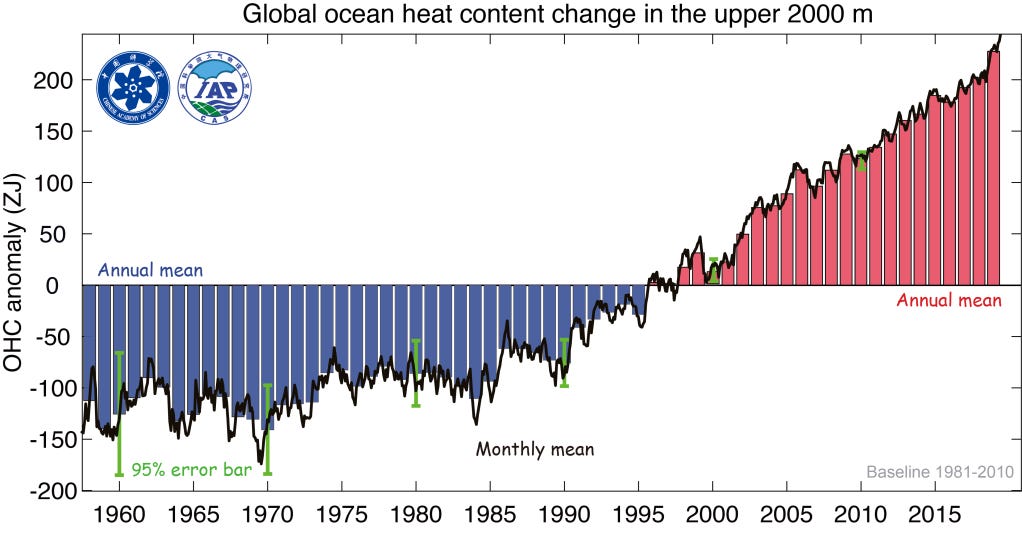
A new study published this week in the journal Advances in Atmospheric Sciences found that our oceans — which absorb about 90 percent of the increased heat in the atmosphere from global warming — took in and held an absolutely massive amount of solar energy last year.

As Damian Carrington, the Environment Editor at The Guardian, put it in a recent article summarizing that new study:

“The oceans absorbed about 10 zettajoules more heat in 2022 than in 2021, equivalent to every person on Earth running 40 hairdryers all day, every day.”

Clearly, all 8 billion of us aren’t anywhere close to using the power equivalent of 40 hairdryers all day, every day. But that’s the amount of extra energy our planet is trapping every year at our current rate of energy consumption because greenhouse gasses are so very efficient at trapping solar heat.

As a result, our oceans are warming. And that’s driving “atmospheric rivers,” derechos, “bomb cyclones,” and a whole variety of other atmospheric phenomenons we’d never seen or even heard of before the past decade or two.

Graph of global ocean heat content change in the upper 2,000 meters of the ocean, showing the monthly average by year as compared to the annual average, for 1955–2019. Courtesy of NOAA NCEI and IAP.

Again, it’s not our energy use that’s driving this. It’s the carbon waste byproduct — mostly CO2 — of the fossil fuels we’re burning to create that energy that’s doing most of it.

If we were simply capturing all our energy from the sun and wind, that blanket of greenhouse gasses wouldn’t keep growing, the heat wouldn’t continue accumulating, and our atmosphere might stabilize (assuming — and it’s not a safe assumption — that we haven’t already passed tipping points that can’t be reversed).

By the 1970s it was common knowledge across the scientific community that these greenhouse gasses — particularly CO2 and methane — were warming our planet. As you can see from the graphic above, it became irrefutable by the 1990s.

In 1979 President Jimmy Carter pointed to this knowledge and these trends and took action to try to stop the crisis the world is now experiencing.

“The energy crisis is real,” Carter told the nation. “It is worldwide. It is a clear and present danger to our nation. These are facts and we simply must face them.

“What I have to say to you now about energy is simple and vitally important.

“Point one: I am tonight setting a clear goal for the energy policy of the United States. Beginning this moment, this nation will never use more foreign oil than we did in 1977 -- never.”

He declared a national crisis that year and proposed legislation to create:

“[T]his nation’s first solar bank, which will help us achieve the crucial goal of 20 percent of our energy coming from solar power by the year 2000.”

Tragically for America and the world, it all came crashing down 43 years ago this month when the fossil fuel industry’s candidate, Ronald Reagan, replaced Carter, killed the solar bank and the solar bond program, and even took Carter’s solar panels off the roof of the White House.

Reagan embraced the fossil fuel industry with gusto (and they embraced him back), promoting climate deniers like James Watt to head the Department of the Interior (which oversees oil, gas, and coal drilling and mining), and Neil Gorsuch’s mother, Anne Gorsuch, to head the EPA.

Simultaneously, the fossil fuel industry began throwing millions of dollars a year into sellout scientists and climate deniers while pouring billions around the world into politicians and political campaigns.

As a result, we actually increased our consumption of fossil fuels — and the fossil fuel industry made hundreds of billions in profits. Our World in Data summarizes it well:

Electric cars are a huge step forward because they don’t consume fossil fuels (transportation is our second-largest producer of greenhouse gasses), but most of our world’s electricity is still produced using coal, oil, or natural gas.

President Carter tried to save America — and lead the world away — from the climate disasters that are killing millions of people around the world every year. The fossil fuel industry and the Republican Party killed his efforts here, as have “conservative” political parties and the fossil fuel industry all around the world.

It’s gotten too late to consider this anything other than a potential Armageddon.

We’ve reached the crisis point where we can no longer afford anything even close to business as usual. This is a climate emergency.

Yet here in America the Republican Party continues to deny climate change and Republican politicians do everything they can to block green and renewable fuels, all in service to a grotesque industry that makes billions in profits every year from killing our planet.

But we are not without solutions.

Heating our houses and places of business, for example, represents our biggest use of fossil fuels. Yet in Urbana Illinois, Vancouver Canada, and across Germany they’re building homes that are so efficient they can be… wait for it… heated with a single hairdryer.

A new and better world is possible, if we can only overcome the money of the fossil fuel industry, the corruption of a political party, and stop squandering the little remaining time we have before, if we don’t act, climate disasters overwhelm civilization. 

Tuesday, January 10, 2023

10 steps you can take to lower your carbon footprint (Washington Post)

Here's the intro to the article - link to full article is below:

Here’s the thing: Small changes alone won’t save our planet. To keep the Earth from warming above the critical 2 degrees Celsius (3.6 degrees Fahrenheit) limit, climate action needs to happen at an institutional level. The Washington Post has built a tracker to keep you up to date on all of President’s Biden’s environmental actions.


But that doesn’t mean you should feel helpless, or that your actions aren’t worthwhile. Taking steps to lower your own carbon footprint may help ease your climate anxiety by giving you back some power — and even the smallest of actions will contribute to keeping our planet habitable.


With that in mind, here are 10 places to start.


Subscription-free link to the full articlehttps://wapo.st/3CDpVXo


Monday, September 6, 2021

It's All About 'Ownership' -- How Much of America Do You 'Own"

  I’ve always been a person who hated litter. When I find litter on a trail, I will pick it up and usually carry a bag for that purpose. When I walk my dog, I always carry extra poop bags so I can pick up the poop other dog owners have failed to pick up.

I don’t say this to garner praise, but to make a point. It started with a thought I had as a teenager about people who throw litter from their cars. It’s the following: I believe that people who throw trash from their car hate litter as much as I do. They don’t want litter in their car, which they own. They simply don’t have a sense of ownership that extends beyond their personal property. Myself, I have that sense of “ownership” of the world around me, and I want to keep it as litter free as my car or home.

Think of it, if you prefer, as “citizen-ship.” I’m a citizen of Golden, but I’m also a citizen of Colorado, of the United States and, yes, of the planet. I want to keep Golden, Colorado and my planet clean, healthy, and sustainable.

As a citizen of the planet, I worry about plastics and microplastics in our oceans, about air and water pollution, and about climate change. I take seriously what scientists tell me, whether it’s about viruses, vaccines, or our climate. Fortunately, most of my fellow citizens feel as I do. The entire world listened to scientists 40 years ago, when they told us CFCs were creating an “ozone hole” endangering human health. The world responded by banning CFCs, and the ozone hole has now closed, according to the European Environment Agency. 

The entire world also listened in 2016 when it passed the Paris Climate Accord, but one nation — the United States — withdrew from that accord when a person without our world view became president.

Diversity (the acceptance of equal rights and respect for people unlike yourself) goes hand-in-hand with global citizenship. Racism is a logical extension of that narrow world view. “America First” is the antithesis of that sense of ownership or citizenship of the planet. Make America Great Again, as I have written before, is demonstrably the same as “Make America White Again.”

There’s a theme of self-centeredness among those who have gravitated toward our supremely narcissistic, even psychopathic, former president and his worldview. Self-centered people are people who might litter, might not care about recycling, and think we can keep exploiting the earth’s resources without worrying about the consequences. They might not be as compassionate toward the suffering of immigrants or the homeless or the unemployed. They would definitely favor tax cuts for themselves over improved social services for those less blessed than themselves.

Is this a theme that resonates with you? If not, perhaps you agree with this unsigned letter I received from a reader last week:

“I see you are still writing your hysteria and paranoid rants against the great Donald J. Trump. What kind of businessman pisses off half of his possible clientele? What kind of fool pays the Post for an opportunity to put his head up his ass on a weekly basis?

“In case you haven’t noticed, the idiot in charge in a five-star cluster fuck of epic proportions.

“On every social and foreign policy question, Trump was absolutely correct. Learn how to deal with it, ass-hole.”

This reader needn’t worry about me “pissing off half my possible clientele” by speaking the truth about Donald J. Trump. Frankly, I wouldn't want to do business with a Trumper, and I’m being rewarded by other readers with the best year of my career, receiving so many leads that I have to enlist my broker associates to serve them all.

  More typical is the following email message I got from David M.:

Donald Trump did not make America great again. Trump made America far less great, more divided, and far less honest. To this day, I continue to be so amazed at the folks who believe Trump made America better and I’m even more flabbergasted at the Republicans who are in denial and continue to be so.

  More typical is the following email message I got from David M.:

Donald Trump did not make America great again. Trump made America far less great, more divided, and far less honest. To this day, I continue to be so amazed at the folks who believe Trump made America better and I’m even more flabbergasted at the Republicans who are in denial and continue to be so.


Tuesday, August 24, 2021

Every President Leaves a Legacy, So What Will Donald Trump’s Legacy Be?

    As our country struggles to recover from the Trump presidency, it’s hard not to think about what Pres. Donald Trump’s legacy will be. We’re living it every day.

If you Google “Donald Trump’s legacy” (with the quote marks so you only get hits with those words in that order), you get 57,000+ hits, and it’s interesting to see the various takes on his legacy. The #1 hit is, appropriately, from the BBC, which has the useful perspective of being British but with a nightly news program on public television, which I record and occasionally watch. (There is an entire BBC America channel on both Dish Network and DirecTV.)

That article makes the observation that “If Donald Trump had followed the example of his predecessors and conceded power graciously and peacefully, he would have been remembered as a disruptive but consequential populist leader…. a president who, before the pandemic, presided over an economic boom, re-oriented America's opinion of China, removed terrorist leaders from the battlefield, revamped the space program, secured an originalist (conservative) majority on the US Supreme Court, and authorized Operation Warp Speed to produce a Covid-19 vaccine in record time.”

Indeed, the legacy of Donald Trump turned on his Jan. 6th incitement of violence because he could not accept defeat, an aspect of his personality so well laid out in his niece Mary Trump’s book, “Too Much and Never Enough.”

But that was not his first incitement of violence. At least one clip from his many rallies comes to mind where he encouraged his followers to assault a protestor, declaring that he would pay the legal expenses if they were prosecuted.

The BBC article describes his Alt-right followers as “Trump’s shock troops,” and indeed they were just that, appropriately reminiscent of the Nazi Brownshirts, aka Storm Troopers.  A big element of Trump’s legacy will be his emboldening of violent right wing extremists, including white supremacists, epitomized by his response to the Charlotteville “Unite the Right” rally.

Trump’s “Big Lie” about losing the 2020 election due to fraud and his emboldening of right-wing extremists is his most enduring legacy (in that we are living with it well beyond his term in office), but there are other important elements of his legacy worthy of highlighting.

We lost four years of leadership in addressing climate change, which poses an existential threat to our planet. He cut funding for renewable energy and boosted support for coal and other fossil fuels. He emboldened climate deniers, but that was just one element of a larger denial of science. We’re living with that legacy not only in the forest fires and drought plaguing our country but in lives lost due to vaccine hesitancy and misinformation, which he fostered despite taking credit for Operation Warp Speed.

Trump’s damage to the Republican Party may or may not be long lasting, depending on how successful the party, propelled by his rhetoric, is in the 2022 and 2024 elections. Losses in those elections would be a second repudiation of Donald Trump and could, hopefully, lead to a return to the GOP of old which did, for the most part, put country above party — at least until the election of Barack Obama, when it truly assumed the role of being the “Party of No” under the leadership of Sen. Mitch McConnell.

Trump’s reshaping of the judiciary, not just the Supreme Court, will be an enduring legacy, too. With the help of Sen. McConnell, he appointed over 250 judges, most of them recommended by the conservative Federalist Society. The American Bar Association rated 10 of Trump’s appointees “unqualified,” but the Senate confirmed them anyway.

Donald Trump succeeded as no previous president has in demonizing the free press, or what he called the “lamestream media.”  (The use of insult name-calling is also part of his legacy.) If a news item didn’t flatter him, it was deemed “fake news” and his followers believed him. He called the free press “the enemy of the people,” but saying so identifies Trump as the true enemy of the people.


Wednesday, August 19, 2020

Okay, Enough About Trump’s ‘Flaws.’ Let’s Look at His Policies & Goals

It’s easy to focus on the many personality flaws of President Trump, and his supporters keep telling me to focus instead on his wonderful policies and accomplishments. So here we go.

I was inspired by this email I got from a reader, Larry C.:

I wish you would try to explain just what these people think Trump has been so great in accomplishing, and what are the policies they so agree with. 

Tax cuts for the wealthy that have put the national debt into the stratosphere?

Appointing judges who, with few exceptions, will rule against the working class in favor of monied special interests?

Destroying environmental regulations that benefit only the energy companies. 

Trade policies that have raised prices for all of us while seriously hurting Midwest farmers?

Constantly kowtowing to Putin and other dictators as he works to destroy our NATO relationships?

    It can only be that they like his immigration position, and in that way they identify with Trump’s racism. That’s all there is to it.

What Larry didn’t mention, but is equally important, is Trump’s denial of climate change — not merely denial, but a policy of neglect toward mitigating the effects of climate change, which are becoming more real every day and every year. 

I remember hearing that right after Trump took office, he ordered that the words “climate change” be banned from the Environmental Protection Administration’s website. A search of epa.gov now shows over 20,000 mentions of the term (link)  It remains true, however, that the president pulled the United States out of the Paris Accord on Climate Change and has actually worked to promote fossil fuels which contribute to climate change. Because of the consequences of climate change, this policy will be among the worst legacies on the Trump administration, and the damage from failure to focus on the topic is already apparent in the wildfires and severe weather we are experiencing every year. Had you heard of “derecho” before this year? How about “polar vortex”? I lived on the east coast for 40 years and remember one or two hurricanes and no “super storms.” This is clearly a crisis requiring presidential leadership, not total neglect.

One of my first “Talking Turkey” columns had the headline, “Covid-19 Is Putting Trump’s Disdain for Science to the Test. How’s He Doing?” (link).

I think we know the answer now better than ever.


Wednesday, April 8, 2020

Covid-19 Crisis Is Putting Trump’s Disdain of Science to the Test. How’s He Doing?


As I witness the unfolding of the Covid-19 pandemic in our country and our president’s handling of it, I find myself thinking about climate change.
Some cartoonist will draw a cartoon of Trump being hit over the head by a 2x4 labeled “Covid-19” and “Science.”
The pandemic is, hopefully, a wake-up call for Trump regarding the importance of science in addressing the world’s challenges, such as climate change.
Trump has said he knows more than the generals, more than the experts in every field of study. He bathes in the adulation of evangelists who actually believe that he was sent by God to save our country, to “make America great again.” They truly think he can do no wrong.  Or can he?
I’ll never forget the 2-hour Frontline program on Sept. 27, 2016, called “The Choice 2016” about Donald Trump and Hilary Clinton, which I wish PBS would air again.  You can watch the full program online.
In that Frontline report, we learned about “the Donald’s” personality in ways that ring even more true now that we’ve experienced over 3 years of him playing the role of President.


Fast forward to 36:18 of that documentary to see how Trump found a mentor in Roy Cohn, a lawyer hired to defend the Trump Organization in a federal lawsuit alleging racial discrimination in their rental properties. In the following 4 minutes of that documentary you’ll see exactly where Donald Trump acquired the persona which we see every day in our president. The key rules instilled by Roy Cohn are:
  • Never settle or admit anything, never admit a mistake
  • If someone hits you, hit back harder and never stop
  • Even when you lose, claim victory
  • Tell a lie long enough and people will think it’s the truth
  • Use lawsuits like machine gun bullets
  • Take no prisoners
Roy Cohn was described as a “street fighter,” and in Donald Trump we see what it’s like when a street fighter becomes president.
I believe that history will not be kind to Donald Trump once he is gone, nor will it be kind to those who fell under his spell, whether they are US Senators or Representatives or ordinary citizens. The 2018 elections were the first proof that.


Tuesday, March 10, 2020

What Values Would You Like to See Reflected in Our Social & Political Discourse?


Like many of you, I have stood by in dismay, watching the decline of civility and the rise of extremism in American society over the past few years.
There was a time — very recently, in fact — when politicians spoke respectfully of their political opponents, when they didn’t assign them crude nicknames, and when they weren’t outright mean to each other.
There was a time when the anchor of the CBS Evening News, Walter Cronkite, was “the most trusted man in America” and factual reporting of events was respected and not discarded as “fake” or “partisan” news.
There was a time when the work of scientists was respected. Indeed, the word “STEM” entered the dictionary as Americans saw the value of promoting science, technology, engineering and math in school curricula.
There was a time when 99% agreement (actually, less than that) among scientists on topics like global warming was considered enough to consider it “settled science.”
Americans fooled themselves after the election of Barack Obama into thinking we had entered a “post-racial” era, but now we realize racism will never die. Instead there are times when it’s not considered appropriate to voice those impulses or put them into action.
The election of Donald Trump was different. Seeing and hearing the President of the United States mirror one’s own thoughts emboldens him or her to express them or perhaps take to the streets with them, as we saw in the 2017 “Unite the Right” rally in Charlottesville. Thus emboldened, they often go further than the President, such as when the demonstrators chanted, “Jews Will Not Replace Us!” Making matters worse afterwards was when the President said there were “very fine people” among those demonstrators.
What brought this topic to mind for this inaugural edition of this column was a segment on last week’s Bachelor program on ABC, “The Women Tell All,” in which Rachel Lindsay described the hate and death threats which she endured as an African-American celebrity when she was the “Bachelorette.” The black women who were contestants in this season’s Bachelor program nodded their heads in acknowledgement of experiencing similar hatred.
That’s what has been so destructive of the current presidency — the emboldening of racists, white nationalists and others who in years past would have kept those thoughts to themselves and their loved ones, and certainly not acted on them as they so freely do nowadays.
But there’s more.
The President’s baseless demeaning of the mainstream media, abetted shamelessly by Fox News, has not been fatal — the press will survive and thrive after this president is gone — but it has contributed to the emboldening referred to above.
The most serious long-term effect of this presidency, however, will be the four-year hiatus in the national effort to address climate change. This is a president who has given voice to that 1% of climate scientists who are blind to this worldwide threat at a time when action is so critical. Fortunately, cities, states and corporations have understood the threat and are, to an extent, taking up the battle without the White House support they should be receiving.  Let’s hope it’s enough.
From the beginning, most Americans recognized Donald Trump as a narcissist and pathological liar, someone who returned love only for those who loved or pretended to love him through flattery, such as smart ex-KGB officers like Vladimir Putin.
What’s most surprising to me is not just the self-serving Republican enablers who have tied their wagon to Trump’s star, but how many day-to-day Americans see in Trump’s personality something to admire.