Search This Blog

Showing posts with label electric cars. Show all posts

Thursday, January 12, 2023

I Learned Some Things From Thom Hartmann Today -- And Maybe You Will, Too!

 This is today's Hartmann Report, published by Substack:

Hairdryer Climate Mathematics Revealed

Our hairdryer math gets really bizarre when we apply it to global warming

By THOM HARTMANN


Most people know that a hairdryer draws about as much power as your average modern outlet will give it — typically around 1000 watts or, at 110 volts, just shy of 10 amps. (Plug in and turn on two hairdryers from the same outlet and you’ll usually blow a circuit breaker: most homes max out at 15 or 20 amp circuits.)

If those numbers are gibberish to you, hang on: it’ll all have meaning in a moment, particularly when I get to the really shocking part about climate change and hairdryers.

I was recently listening to a rightwing radio talk show host trashing electric cars and the need for them (he was also denying climate change) and he went into this rant about how if everybody in America bought an electric car, charging them would “take down the entire country’s power grid.”

This assertion is, to be charitable, BS. But since we all know what a hairdryer is and have, at least, a sense for how much power one typically uses — the equivalent of ten 100-watt light bulbs — let’s convert an electric car’s power usage into hairdryers.

A typical electric car using a 110 volt home charger pulls about the same amount of electricity when it’s charging as does a hairdryer: between 800 and 1200 watts, or 8 to 12 amps, with an average of 10 amps or around 1000 watts per hour (one kilowatt-hour).

So, charging your car is about the same as running a hairdryer, our new unit of measurement.

The average electric car travels 100 miles on around 30 kilowatts (30,000 watts or 30 “hairdryer-hours”) of electricity (Tesla Model 3 only uses 25, the Chevy Bolt 29), while the average driver in America travels around 1000 miles a month or 33 miles a day: roughly 10 kilowatts or 10 hairdryer hours a day to cover those 33 miles.

So the average driver charging their car overnight for ten hours (to replenish that 10 kilowatts of electricity to travel 33 miles) will use the same amount of electricity as running a single hairdryer for 10 hours.

First off, you can see how silly it is to argue it would “take down the grid” if every family in America were to turn on a single hairdryer in their home for 10 hours every night, the equivalent of everybody recharging 33 miles worth of driving every day.

Particularly because most of that charging is done overnight, when electric demand is lower than normal.

(The average cost of electricity in the US, by the way, is $.10 per kilowatt hour, or ten cents per “hairdryer hour.” So, simple math suggests it costs about $3 to drive 100 miles — 30 “hairdryer hours” worth of electricity x 10 cents per hour — in the average electric car. For comparison, in the average 25 mpg gas-powered car that same 100 miles would consume 4 gallons of gasoline, costing around $16 at four dollars a gallon.)

But our hairdryer math gets really bizarre when we apply it to global warming.

Our planet isn’t warming because we’re all running hairdryers or even cars or home furnaces; it’s warming because the greenhouse gasses we’re pouring into the atmosphere from generating electricity, heating our homes, and driving our gas-powered cars are acting like a giant blanket, trapping heat from the sun in the atmosphere.

In other words, we are not warming the Earth (at least not significantly) with the heat we’re adding: it’s the greenhouse gasses (principally carbon dioxide) that are warming the Earth by trapping heat from the sun that would otherwise radiate out into space.

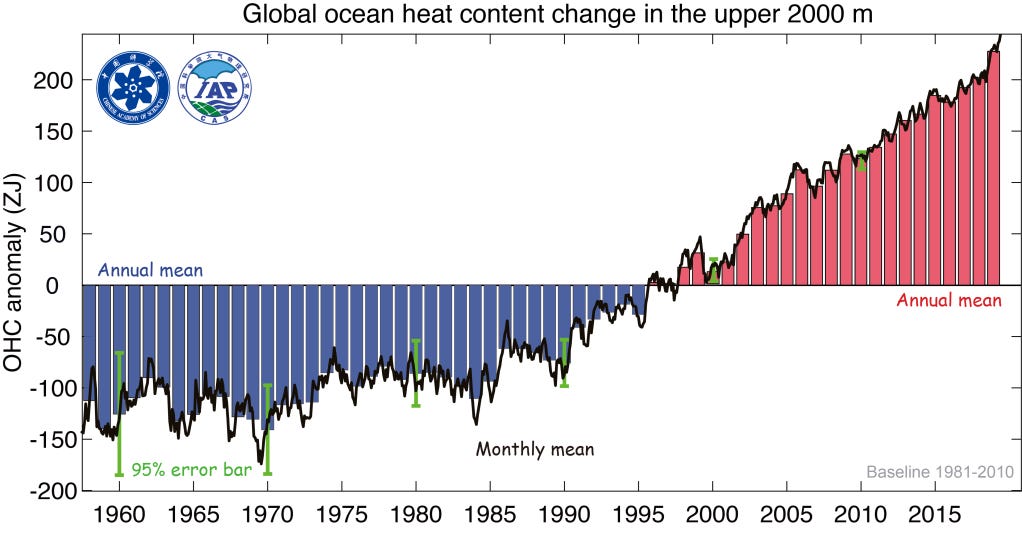
A new study published this week in the journal Advances in Atmospheric Sciences found that our oceans — which absorb about 90 percent of the increased heat in the atmosphere from global warming — took in and held an absolutely massive amount of solar energy last year.

As Damian Carrington, the Environment Editor at The Guardian, put it in a recent article summarizing that new study:

“The oceans absorbed about 10 zettajoules more heat in 2022 than in 2021, equivalent to every person on Earth running 40 hairdryers all day, every day.”

Clearly, all 8 billion of us aren’t anywhere close to using the power equivalent of 40 hairdryers all day, every day. But that’s the amount of extra energy our planet is trapping every year at our current rate of energy consumption because greenhouse gasses are so very efficient at trapping solar heat.

As a result, our oceans are warming. And that’s driving “atmospheric rivers,” derechos, “bomb cyclones,” and a whole variety of other atmospheric phenomenons we’d never seen or even heard of before the past decade or two.

Graph of global ocean heat content change in the upper 2,000 meters of the ocean, showing the monthly average by year as compared to the annual average, for 1955–2019. Courtesy of NOAA NCEI and IAP.

Again, it’s not our energy use that’s driving this. It’s the carbon waste byproduct — mostly CO2 — of the fossil fuels we’re burning to create that energy that’s doing most of it.

If we were simply capturing all our energy from the sun and wind, that blanket of greenhouse gasses wouldn’t keep growing, the heat wouldn’t continue accumulating, and our atmosphere might stabilize (assuming — and it’s not a safe assumption — that we haven’t already passed tipping points that can’t be reversed).

By the 1970s it was common knowledge across the scientific community that these greenhouse gasses — particularly CO2 and methane — were warming our planet. As you can see from the graphic above, it became irrefutable by the 1990s.

In 1979 President Jimmy Carter pointed to this knowledge and these trends and took action to try to stop the crisis the world is now experiencing.

“The energy crisis is real,” Carter told the nation. “It is worldwide. It is a clear and present danger to our nation. These are facts and we simply must face them.

“What I have to say to you now about energy is simple and vitally important.

“Point one: I am tonight setting a clear goal for the energy policy of the United States. Beginning this moment, this nation will never use more foreign oil than we did in 1977 -- never.”

He declared a national crisis that year and proposed legislation to create:

“[T]his nation’s first solar bank, which will help us achieve the crucial goal of 20 percent of our energy coming from solar power by the year 2000.”

Tragically for America and the world, it all came crashing down 43 years ago this month when the fossil fuel industry’s candidate, Ronald Reagan, replaced Carter, killed the solar bank and the solar bond program, and even took Carter’s solar panels off the roof of the White House.

Reagan embraced the fossil fuel industry with gusto (and they embraced him back), promoting climate deniers like James Watt to head the Department of the Interior (which oversees oil, gas, and coal drilling and mining), and Neil Gorsuch’s mother, Anne Gorsuch, to head the EPA.

Simultaneously, the fossil fuel industry began throwing millions of dollars a year into sellout scientists and climate deniers while pouring billions around the world into politicians and political campaigns.

As a result, we actually increased our consumption of fossil fuels — and the fossil fuel industry made hundreds of billions in profits. Our World in Data summarizes it well:

Electric cars are a huge step forward because they don’t consume fossil fuels (transportation is our second-largest producer of greenhouse gasses), but most of our world’s electricity is still produced using coal, oil, or natural gas.

President Carter tried to save America — and lead the world away — from the climate disasters that are killing millions of people around the world every year. The fossil fuel industry and the Republican Party killed his efforts here, as have “conservative” political parties and the fossil fuel industry all around the world.

It’s gotten too late to consider this anything other than a potential Armageddon.

We’ve reached the crisis point where we can no longer afford anything even close to business as usual. This is a climate emergency.

Yet here in America the Republican Party continues to deny climate change and Republican politicians do everything they can to block green and renewable fuels, all in service to a grotesque industry that makes billions in profits every year from killing our planet.

But we are not without solutions.

Heating our houses and places of business, for example, represents our biggest use of fossil fuels. Yet in Urbana Illinois, Vancouver Canada, and across Germany they’re building homes that are so efficient they can be… wait for it… heated with a single hairdryer.

A new and better world is possible, if we can only overcome the money of the fossil fuel industry, the corruption of a political party, and stop squandering the little remaining time we have before, if we don’t act, climate disasters overwhelm civilization. 

Wednesday, June 28, 2017

Our Favorite Sustainability Practices & Improvements


By JIM SMITH, Realtor®
   Golden Real Estate is known for its sustainable practices. Indeed, we were recognized as early as 2010 with the City of Golden’s Sustainability Award for Business.
   Here are some of the practices and improvements which earned us this award, plus some measures we’ve taken since 2010 to deepen our commitment to sustainability.
   Recycling of Styrofoam: We have a “Styrofoam Corral” behind our office where anyone can drop of their block white polystyrene (aka Styrofoam, which is a brand name) 24/7.  At least once a month, we take a truckload of this material to a reprocessing center in Denver, keeping over 200 cubic yards of it out of landfills annually.
  Solar Power: Our office (and my own home) have enough solar panels to power not only our office, but our electric cars. In addition, we have two ChargePoint charging stations for EV’s that are free to the public.
  Reusing trash bags: I can’t remember the last time I purchased trash bags. We dump our trash and recycling materials loose into the trash carts, then reuse the plastic bags over and over again.
  Super insulation of home and office: Insulation is the smartest way to save on energy — and has the biggest return on investment (ROI). By hiring GB3 Energy to do an energy audit and install basement, crawl space and attic insulation as well as caulking windows, we have significantly reduced our heating and cooling costs.
  Driving electric cars:  I have driven nearly 200,000 miles on electricity in my Chevy Volt and Tesla cars. The lifetime MPG for the Volt (which has a range-extending gas engine) is over 200 mpg. Back in 2015 I drove my Tesla round-trip to Connecticut, and the only cost was the wear on my tires thanks to the free Supercharging. New Teslas don’t have unlimited free Supercharging — unless you’re referred by a current owner. Use my referral code to get a $1,000 discount and that free charging: http://ts.la/james6985.
  Solatubes: The generic name for these alternatives to skylights is “sun tunnels.” (Solatube is a brand name; my favorite brand is Velux.)  By installing Velux sun tunnels in our office and at home, we use less electricity for lighting — saving us more electricity to power our automobiles!

Published June 29, 2017, in the Denver Post's YourHub section.
 

Wednesday, June 21, 2017

Clearing the Deck: Topics Worthy of Mention, But Not a Full Column


     Call this “Short Attention Span” writing… There are numerous topics I’ve been wanting to write about that keep accumulating because I can’t fashion them into a full-sized column. So, this week, lacking a “big topic” that comes to mind, I’m going to clear the deck of these “tiny topics.” Maybe some of them will resonate with you!

Sixth Grade Classes Are Being Moved to the Middle Schools
     Educators and many parents have concluded that sixth graders would do better in a school with 7th and 8th graders, and the Jeffco School Board has already begun to make that change. What you may not know is that if your 6th grader is still assigned to the elementary school, you can “choice” that student into the middle school. That’s the official term for it — I find it interesting that our educators have decided that “choice” can be a verb, not just a noun…

You May Want to Put Your Home in a Trust Instead of in Your Name
    Experts recommend that you not put your home in your own name, but in a living trust. Why? Because people die, trusts don’t. When you die with a home in your name, a court has to decide who gets your house, even if you have a will. If it’s in a trust, you decide who the successor trustee is, and you can change the trustees over time.
     I like what Linda Sommers, the estate law lawyer whose “Linda Leaving a Legacy” appears in YourHub, likes to say: “Everyone has an estate plan; if you don’t have one of your own, the state has one for you.”

VA Loans, Even Up to $1.5 Million, Can Make Sense for Veterans
      Plain vanilla VA loans — with no down payment up to $493,350 in the Denver metro area — are a great veteran’s benefit, but they do carry a “VA Funding Fee” of 2.15% of the loan amount. That fee drops to 1.5% if you put down 5% or more and to 1.25% if you put down 10% or more of the purchase price. On a $400,000 loan, that fee can total $8,600. But if you’re a veteran with a service-connected disability, the fee is waived. 
     A lot of veterans don’t realize that they can buy homes well above the VA loan limit mentioned above. They can borrow 100% up to that loan limit and 75% of any amount over that limit. Thus, you could buy a $1 million home using a VA loan with a down payment of $126,662.50, or about 12.7%. Generally speaking, you need a 620 credit score to get a VA loan, but the VA doesn’t mandate a minimum credit score. Another advantage of VA loans is that even loans with zero down payment are not charged mortgage insurance.

Sellers Deserve to Receive Quality Feedback on Showings of Their Home       
     One of the most valuable features of using a professional showing service is the automated request for feedback which is sent to the showing agent by email right after each showing.
      When you interview a listing agent, be sure to ask (1) whether they use a showing service (we recommend Centralized Showing Service, which dominates that industry), and (2) how many and what kind of feedback requests will be emailed to agents after the showing.
     CSS offers two kinds of emails — one with multiple choice survey questions which the agent (with your input) can write; or the non-survey kind which asks for feedback and provides the agent with an open text field.
     Because you can’t predict the feedback you will receive, I recommend you request the non-survey, open-ended kind of email request, so you get the most useful possible feedback from buyers.

Tiny Houses Are a Trend, Not a Passing Fad, Denver Business Journal Reports
     On April 3, the Denver Business Journal had a headline that read, “Tiny Houses Are Big Business,” and described the Sprout Tiny Homes factory in LaJunta, Colorado. The company makes five models up to 14.5 feet wide by 34 feet long and up to 760 square feet — less than the size of a 4-car garage.
    A tiny house was on Boulder’s Green Homes Tour last year, and the owners raved about it. Visitors, including me, liked what they saw, and it’s clear to me that tiny homes are going to continue to catch on.  In Denver, tiny homes are being built as a partial solution to the homeless problem. Smart!

Why Are Auto Manufacturers Still  Building Petroleum Fueled Cars?
     I recently read that half the cost of building a conventional gas-powered automobile is related to the gas engine — everything from the cooling system to the transmission to the exhaust system.  An electric car has just a battery and an electric motor, with only wires connecting them. Not even a transmission!
     Even without a further decline in the cost of the batteries — and Bloomberg predicts a 77% additional decline in battery cost by 2030 — building an electric vehicle is easier and less resource consuming, and is better for the environment.  Volkswagen says it will produce 30 new models of battery electric cars across its 12 marques (which include Audi, and Porsche) by 2020. Consumers can help accelerate this conversion in manufacturing by declining to purchase cars which, I believe, are already obsolete.

Invite Me to Deliver My 30-Minute Presentation on Sustainability
      Perhaps you’ve seen my presentation on EV’s at www.GasCarsAreObsolete.info. I recently created a presentation on the broader topic of sustainability. See my slides at  www.SustainabilityPresentation.info.

Bonuses Paid to Buyers’ Agents Could Pose a Serious Ethical Question
      Sometimes the “broker remarks” in an MLS listing will offer a cash bonus to the buyer if he brings an offer by a particular date or for full price.  At Golden Real Estate, we do not condone this practice because of its questionable ethics.
     Agents are supposed to work in their clients’ best interest. “Broker remarks” are not visible to buyers, and there’s the possibility that an agent might steer his buyer to purchase a home solely because it earns him a higher commission, which would be unethical in our opinion. We believe that any financial incentive should be offered to the buyer, not the agent.


Published June 22, 2017, in the Denver Post's YourHub section and in four Jefferson County weekly newspapers.